
At the Heart of the Movement: Love, Relationship, and How We Show Up
February 2, 2026
During the winter months, we take time to pause during this season of stillness and quiet. The quiet gives us space to reflect on the previous season and prepare for the upcoming season. The quiet is a space to receive clarity, spark creativity, and renew our commitments and responsibilities to ourselves, our families, our communities, and to the natural world. Reflecting on this past year here at Skanikulat, gave me time to think about the intentional movement we are building here. A movement that centers the revitalization of the Oneida language through language-medium (immersion) education within a context of wellness, joy, creativity, fun, rest, safety, accountability, responsibility, respect, and love. These are the seeds we are planting in the movement. Of all these seeds, it is without a doubt, that the heart of this work is love. Equally, love is at the heart of every movement. Love shows up in practice, discipline, and responsibility. It is what helps us overcome barriers, challenges, and mountains that we never thought we could climb. Love is magnetic and brings people together from all walks of life. In community, love is the center. Love is the lifesource that must always be nurtured and is what carries us through the hills of life that we encounter. To nurture our lifesource of love, we must bring our awareness within ourselves and build our courage, effort to try, our capacity to both fail and succeed, listen to others, show care, uncover our intentions, acknowledge our impact, express gratitude, freely express ourselves, and use these pieces needed to show up in a way that supports our desire to express our outward love for the movement. It is not easy, nor is it perfect, but when we continue to try, we realize that love does not seek perfection, it seeks presence, consistency, and effort. We learn as we go and we learn as we grow. Expansion and evolution in any movement is necessary for survival - that is continuity in motion. Change is the only constant. As part of a larger Indigenous language movement across Turtle Island, these ideas are embodied values that drive the direction of our work, because future generations depend on what we do now. These movements are generational, with no real end date, with a constant awareness that this work will continue beyond our time here and by those not yet here. These actions are relationality in motion, a key part to movements - relationships. I share this during our still season, as a way to send encouragement and to renew the work in love for our language for another season.
Roles for all in the Oneida Language Revitalization Movement
Within this movement, there are roles for everyone. That is what makes a community a collective. Part of our individual responsibility is to identify our purpose as part of our motivation to support the work. Each part of the work is needed to maintain the whole - similar to an ecosystem - every plant, insect, animal, ray of sunlight, breeze of wind, raindrop, and organism play a vital role in maintaining the balance of revitalizing the Oneida language. None of these roles are the same, nor have the same responsibilities. The roles don't all do the same, nor look the same. Some are more behind-the-scenes or under-the-surface, while others are more visible. This is the beauty of community - a diverse array of people, knowledge, backgrounds, skills, networks, and experiences coming together for one purpose: to revitalize the Oneida language. This is the act of embodying 'skanikulat' or 'one mind', which was the intention and seed dreamed of and planted years ago when this organization became a reality. Thus, within this work we know all roles are equally needed, valid, necessary, and important. A language teacher is just as important as a community member who advocates for supporting the revitalization of the Oneida language. An individual who cleans the facilities is just as important and needed as the student learning how to say their name and introduce themselves for the first time in the language. A single mother who drops her children off for language class is just as important as the person developing the curriculum for the class. An individual who donates to a language program is just as necessary as a baby that has yet to be born who will benefit from the language program as a student in the future. The roles are all needed to make the language ecosystem run and maintain balance. Where our reality sits today is that we often have to wear many hats and take on many roles because there simply is never enough funding, capacity, or support. But it is language programs that:
provide cultural knowledge to the community about our cultural practices, traditions, ceremonies, songs, artforms, dances, worldview, and ecological practices.
enhance language proficiency indirectly to family members of students in language programs
create speakership for the future use and survival of our language
produce teachers who go on to create materials, teach in language programs in a community, and work in other fields - bringing that ancestral knowledge with them
share language resources with local schools, community, and anyone that wants to learn
embody Tribal sovereignty and self-determination in its ancestral and pre-colonial form
and so much more
There are roles for everyone in this movement, and I encourage those that are new to the journey to pause and take time to reflect on your purpose and motivation to support the work. This will serve as your personal foundation and be the first step in showing up for the movement. The roles in the Oneida language movement and the movement we are growing here at Skanikulat includes a variety roles that are open to everyone:
Learner, Speaker, Teacher
Family Supporter or Encourager
Advocate or Movement Supporter
Curriculum Developer or Program Designer
Storyteller or Language Carrier
Photographer or Documentarian
Tech Helper or Digital Archivist
Cleaning & Event Support
Volunteer or Donor
Cultural Artist, Beader, Seamstress
Community Builder or Ceremony Supporter
Outreach Helper or Language Cheerleader
and many, many more!
MWEJN Partner Gathering - Minneapolis, MN - November, 2025
In November, I was fortunate to be able to attend the Midwest Environmental Justice Network Partner Gathering in Minneapolis, Minnesota. Minneapolis, my second home, is a place that I always say 'this is where it all began'. This city holds a special place in my heart - it was where I went to college, where I learned from Indigenous scholars, where I was influenced by ideas by the late activist, Vine Deloria Jr., where I saw movements in action, where I learned the history of movements and activism like the birth of the AIM movement, and where I met people from all walks of life. It was where my own understanding as an Indigenous person bloomed. Minneapolis is special, and this blogpost is even more timely with what is happening in the Minneapolis as we speak. As Indigenous people, we know that human rights and the rights of nature are directly interconnected. These rights uphold the balance we seek to maintain as the Original stewards of these lands - rights that are based on respect, dignity, justice, protection, safety, value, and worth. I am reminded of a quote that circulates Indigenous movements often during times like these, which serves as a powerful historic reminder: no one is illegal on stolen land. The truth of this land tells us the natural world is all about movement. Movement as migration, movement as change, movement as expansion, and movement as evolution. The animals, to the winds, to the plants, to the birds, to the waters, all move from place to place, showing us that migration and movement is not unnatural, inhuman, or illegal...despite what colonization leads us to believe. People and place are in direct relationship with one another, therefore human rights are directly tied to environmental justice. We are all relatives within the circle of Creation, directly interconnected and influenced by one other both in rhythm and movement. Above all, it is our environment that tells us this is natural law, a law rooted in ancestral memory, sovereignty, and love.
The MWEJN gathering in November, brought together amazing leaders, organizers, partners, community members, movement-builders, justice seekers, activists, artists, thinkers, problem-solvers, healers, helpers, and supporters to come together to support environmental justice from our different places in the Midwest, from our different worldviews, and our different walks of life. It was a network, a community, filled with support, ideas, power-building, power-mapping, love, help, laughter, joy, creativity, patience, understanding, respect, and some nutritious and delicious food. The local artists spoke, performed, and shared their creative gifts with us at the gathering and the impact was profound. This gave me so much inspiration, motivation, and knowledge building that help me envision what that looks like for me in our community here in Oneida, WI, and what that looks like for the Indigenous Language movement, and what this looks like for the larger movement of Environmental justice that affects us in the Midwest and across the globe. I had so many takeaways from the gathering and wanted to share some of my thoughts after a few months of reflection since the gathering in November.
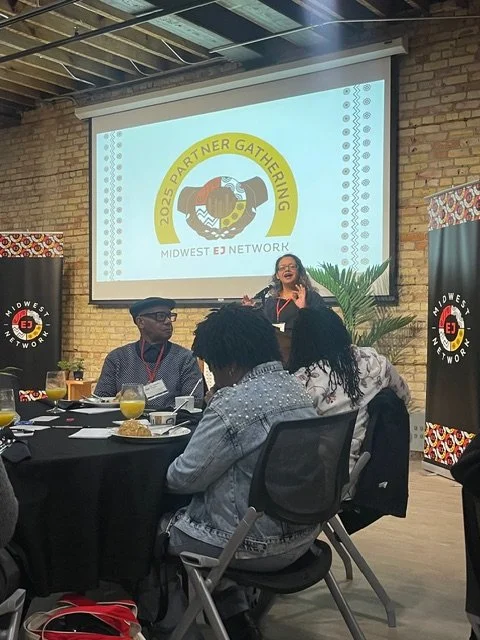
Welcoming remarks by MWEJN gathering emcee, Kim Wasserman, Chair of the MWEJN Leadership Team.
Land Back Is Language Back
The gathering helped me to deeply reflect on the connection between Indigenous languages, land and our environment. A central truth echoed throughout the gathering: land and people are inseparable. It is understood in Oneida worldview and philosophy, that our people are the stewards of our relationship and responsibility to the land and the natural world and are vessels of our Original Instructions and Traditional Knowledge. As Indigenous people, we move that knowledge from ourselves outwardly through the medium of our ancestral languages. Our languages are a spirit and life force that lives within us and in the community, on the land, and across the Universe. Our language is what connects us to the natural world and the vessel of our traditional knowledge. Thus, our people, our languages, and our land are inseparable. The land needs to hear our languages, and our languages need the land. They exist on the same frequency—alive, relational, and reciprocal. When we reclaim language, we restore relationships with land, water, and all of creation. Native American Software engineer and researcher Michael Running Wolf (Northern Cheyenne/Lakota) captures this sentiment beautifully as shared at the Conrad Hilton Humanitarian Symposium in 2024, where he said, “You save the language, you also save the land…ecology thrives where language thrives.” Thus, there is the direct relationship between language revitalization and environmental justice. Creating speakers creates caretakers and stewards of the natural world. Saving our languages helps heal the land—and the land, in turn, helps heal us.
During one of the breakout sessions, I participated in a power mapping activity that helped to 'map the movement' of environmental justice work happening in the midwest. This activity was eye-opening, honest, and extremely empowering. During this activity, a number of questions were given to participants to select and answer and place on the map. One question that stood out to me said 'what was a watershed moment of Environmental Justice in your community?" This question spoke to me, because without a doubt, it was clear what that watershed moment was for my people. That moment was the first and subsequent broken and illegal treaties by the United States that resulted in stolen land, land loss, and ultimately the forced removal of my people from our ancestral homelands (what is now commonly known as New York State) to our home now in Wisconsin over a few hundred years ago. This forced removal of my people harmfully impacted every aspect of our way of life from our kinship practices to traditional agricultural practices to our ceremonial way of life to, ultimately, the stripping of our language. Out of these periods of removal, colonization, and assimilation, one thing developed and thrived: and that is resilience. Our people held onto our ways by a thread for this moment in time, for our generation to pick it up and bring it forward. The gathering reminded me that there is hope out there, and when we come together, we are less isolated in our fight for justice for the movements that are all deeply interconnected.
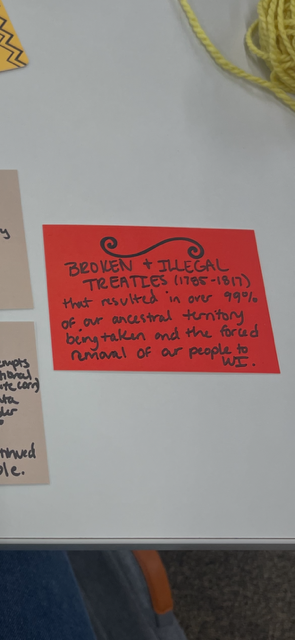
Activity Prompt: What was your watershed moment for Environmental Justice in your community?
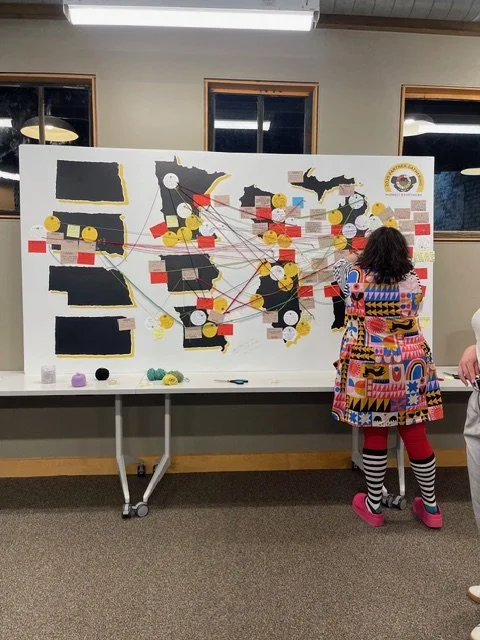
‘Mapping the Movement’ Breakout Session
Collective Grief and Collective Care
As a first year attendee, the strength and building of the network was not only observable, it was deeply felt. There was a sense of love and lightness, especially in the midst of our individual and collective struggles. The reason we were there gathering was to come together to build collectively, while also simultaneously acknowledging collective grief that we are all facing one way or another. This collective grief—grief for a world collapsing under extraction, violence, and disconnection— was the catalyst that brought us together. A space to come together to find our voices, learn how to care for one another and ourselves, and imagine new futures while the old systems crumble. The space of the gathering was built on safety and care, and that space made it inviting to build relationships, trust, and practice deep listening—across generations, across struggles, across communities. As this is what this work requires.
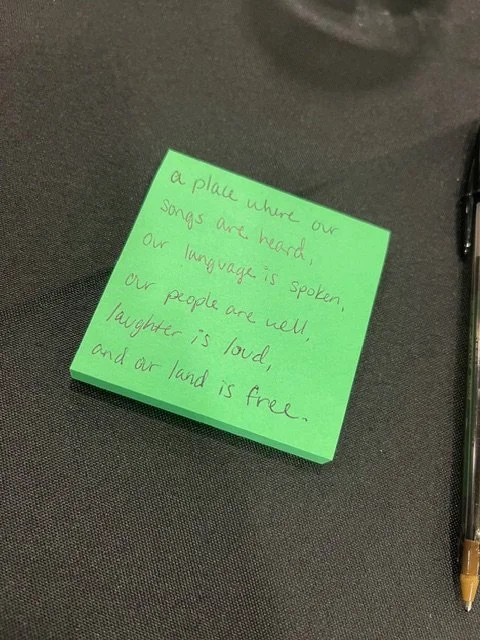
My dream and vision for our community…
Organizing as Relationship-Building
Another theme present throughout the gathering was that movements do not grow through urgency or control, but through trust, listening, and shared values. When relationships are strong, movements can hold complexity, grief, and long-term vision. We were reminded that intergenerational connection matters. When youth and elders learn and build together, continuity is strengthened. Knowledge moves forward, responsibility is shared, and the work becomes grounded in both memory and possibility. At the gathering, artist Ricardo Levins Morales expressed that “Every generation is a link between the ancient past and the ancient future.” Education, in this context of movement building, is not about control or extraction. It is a tool for outreach, connection, and collective growth. When education is rooted in community, it becomes a pathway for empowerment rather than enforcement. Most importantly, this gathering affirmed that our communities already carry the solutions. The wisdom, creativity, and leadership we need are already here.
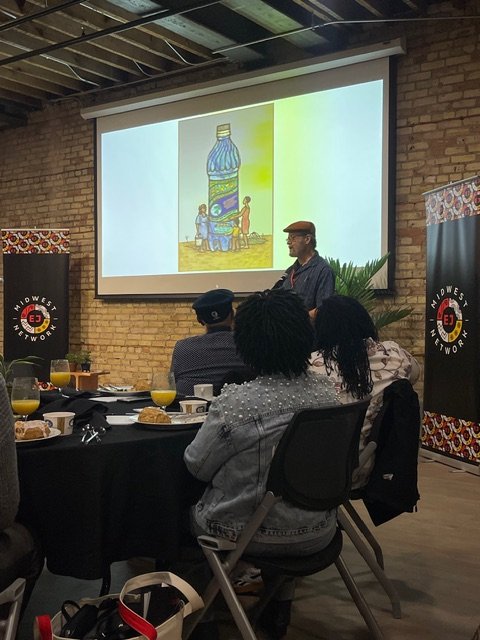
Ricardo Levins Morales is an artist and organizer based in Minneapolis. He uses his art as a form of political medicine to support individual and collective healing from the injuries and ongoing reality of oppression. Ricardo’s work is widely used by grassroots movements, organizations and communities.
Movements Are Cyclical, Not Linear
This gathering served as a powerful reminder that movements are not linear. Change does not move in straight lines or fixed timelines. It unfolds through cycles of loss, grief, renewal, and becoming. When we try to rush transformation, we risk reproducing harm—both to people and to the work itself. Organizing requires patience, deep listening, and an understanding of timing, seasons, and readiness. Not everything can be forced, and not everything is meant to happen all at once. I was truly impacted by Ricardo Levins Morales' presentation and he shared so many powerful sentiments including: “Honor the cycles — we can’t escape them" and “We can’t rush the process of becoming.” Thus, when we honor cycles, we create space for healing, growth, and sustainable change—change that is rooted, intentional, and able to last.
Art and Creative Expression are Instruments of Love, Peace, and Education
Another insight from this gathering was how important art and creative expression is to a movement. Art is not a side piece to organizing—it is central. Art, music, storytelling, and laughter are instruments of peace and love. They heal, educate, and carry the truth of our struggles and our wins—especially the wins that are rarely broadcast. Their work gives language to what communities are living, surviving, and resisting. Art grounds movements in humanity.
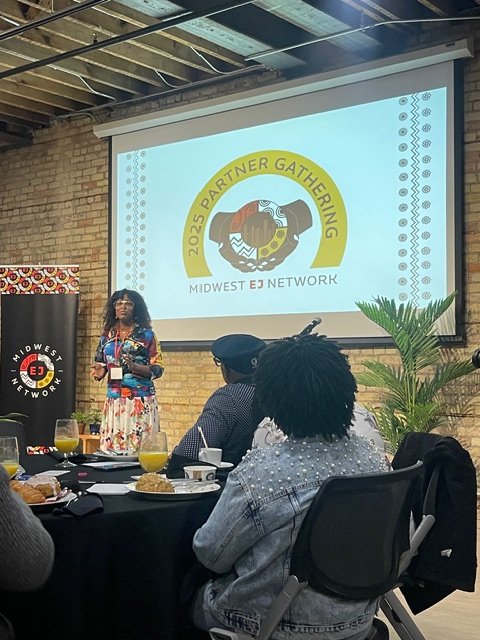
Jayanthi Rajasa is a multidisciplinary teacher, artist, and songstress dedicated to singing from the heart. She collects songs that speak to her struggle, empowerment and ability to move forward, while honoring the unremembered changers and movers of the past. Jayanthi shared her words, song, and spirit with us during the gathering
Community at the Center
Throughout the gathering, there was a strong call to center community voice, especially in planning, visioning, and decision-making spaces. Those most impacted must be at the table. This part of movement building makes space for:
Co-learning
Strategy and resource-sharing
Storytelling of successes and challenges
Intergenerational connection
Building resilience and solidarity
One presenter at the gathering shared something that truly resonated with me: "“Understand global issues, but act locally.” It is local solutions that are necessary for global issues, and the community work happening in Skanikulat contributes to the larger health and wellness of our collective experience and planet we all share.
Wellness Is Central to Sustainable Organizing
Lastly, this gathering centered something truly important and key to the work, but a piece that is often overlooked. That piece is that wellness is not separate from organizing—it is central to it. Rest, boundaries, and embodiment are not indulgences; they are forms of resistance in a world that demands constant output and extraction. Our bodies hold knowledge. They carry signals that guide decision-making, timing, and care. When we listen to the body, we build movements that are more responsive, humane, and sustainable. Healing difficult emotions does not weaken our work—it builds capacity. When we make space for rest and emotional processing, we strengthen our ability to stay engaged for the long haul. By centering wellness, we protect the people doing the work and ensure the movement itself can endure.
I am truly grateful to all those in this community here in Oneida, WI and to those at the MWEJN for their continued partnership and support for our work. The gathering taught me many new approaches, deepened my knowledge on familiar considerations, gave space to share my voice and the voice of my people, and above all, showed me the power of solidarity in action.
-Yekuhsiyo
